


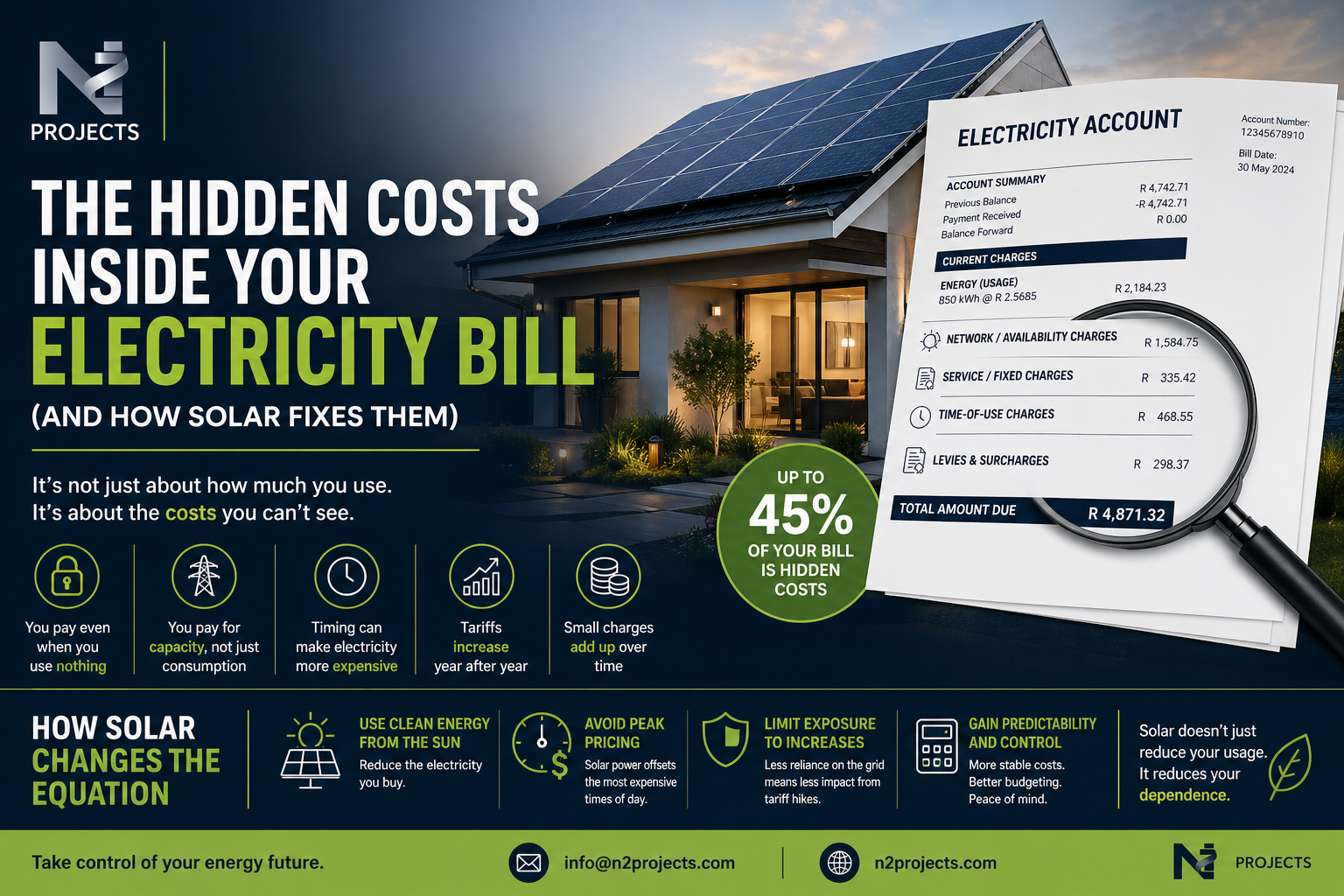


Most people think their electricity bill is simple:
You use electricity.
You pay for what you use.
That would make sense.
But that’s not how the system actually works.
A large portion of your bill has very little to do with how much electricity you use. It is built into the structure of how electricity is priced, distributed, and maintained in South Africa.
Once you understand these hidden costs, two things become clear:
- Why your bill stays high even when you try to reduce usage
- Why solar changes more than just your consumption
1. You Pay Even When You Use Nothing
One of the most misunderstood parts of an electricity bill is this:
You are charged even when you are not using electricity.
These are:
- Service charges
- Basic charges
- Connection or availability fees
They exist simply because your property is connected to the grid.
What this means in practice
- Going on holiday does not eliminate your bill
- Cutting usage to near zero does not remove these costs
- A portion of your bill is fixed every single month
Why it matters
Most people try to reduce their bill by using less electricity.
That only affects the variable portion, not the fixed structure underneath it.
2. You Pay for Capacity, Not Just Consumption
Your electricity supply is not only priced on what you use.
It is also influenced by what your property is capable of using.
This shows up as:
- Network charges
- Capacity charges
- Availability charges
What you are actually paying for
- Grid infrastructure
- Maintenance of supply
- The ability to draw power at any time
Example scenario
Two homes use the same amount of electricity:
- One has a standard connection
- The other has a larger, higher-capacity connection
The second home may pay more overall, even with identical usage.
Why this matters
Higher-value properties are often:
- Larger
- More energy-capable
- Charged more as a result
This is one of the key reasons higher-income households feel like their bills escalate faster.
3. Timing Can Make Your Electricity More Expensive
Electricity is not always priced the same.
Many tariffs include time-of-use pricing, where electricity costs vary depending on when it is used.
Typical structure:
- Peak (highest cost)
- Standard
- Off-peak (lowest cost)
Typical household behaviour
Most energy use happens:
- Early mornings
- Evenings
These are often peak pricing periods.
Result
- You are not necessarily using more electricity
- You are just using it at more expensive times
4. Tariffs Are Not Static
Electricity pricing in South Africa changes regularly.
- Annual increases
- Tariff restructuring
- Municipal adjustments
These changes are outside of your control.
What this creates
- Bills that increase even when usage stays the same
- Long-term cost uncertainty
- Difficulty budgeting accurately
5. Small Charges That Add Up Over Time
Your bill includes multiple smaller charges:
- Environmental levies
- Regulatory charges
- Municipal surcharges
Individually, they seem insignificant.
Together, they contribute meaningfully to the total cost.
Putting It All Together
Your electricity bill is made up of:
Variable Costs
- Energy consumption (kWh)
- Influenced by your behaviour
Structural Costs
- Fixed charges
- Network and availability fees
- Tariff structures
- Levies and surcharges
Typical Breakdown (Illustrative)
- 55–65% → Usage
- 35–45% → Structural costs
This explains why reducing usage does not always lead to a proportional reduction in your bill.
Where Solar Changes the Equation
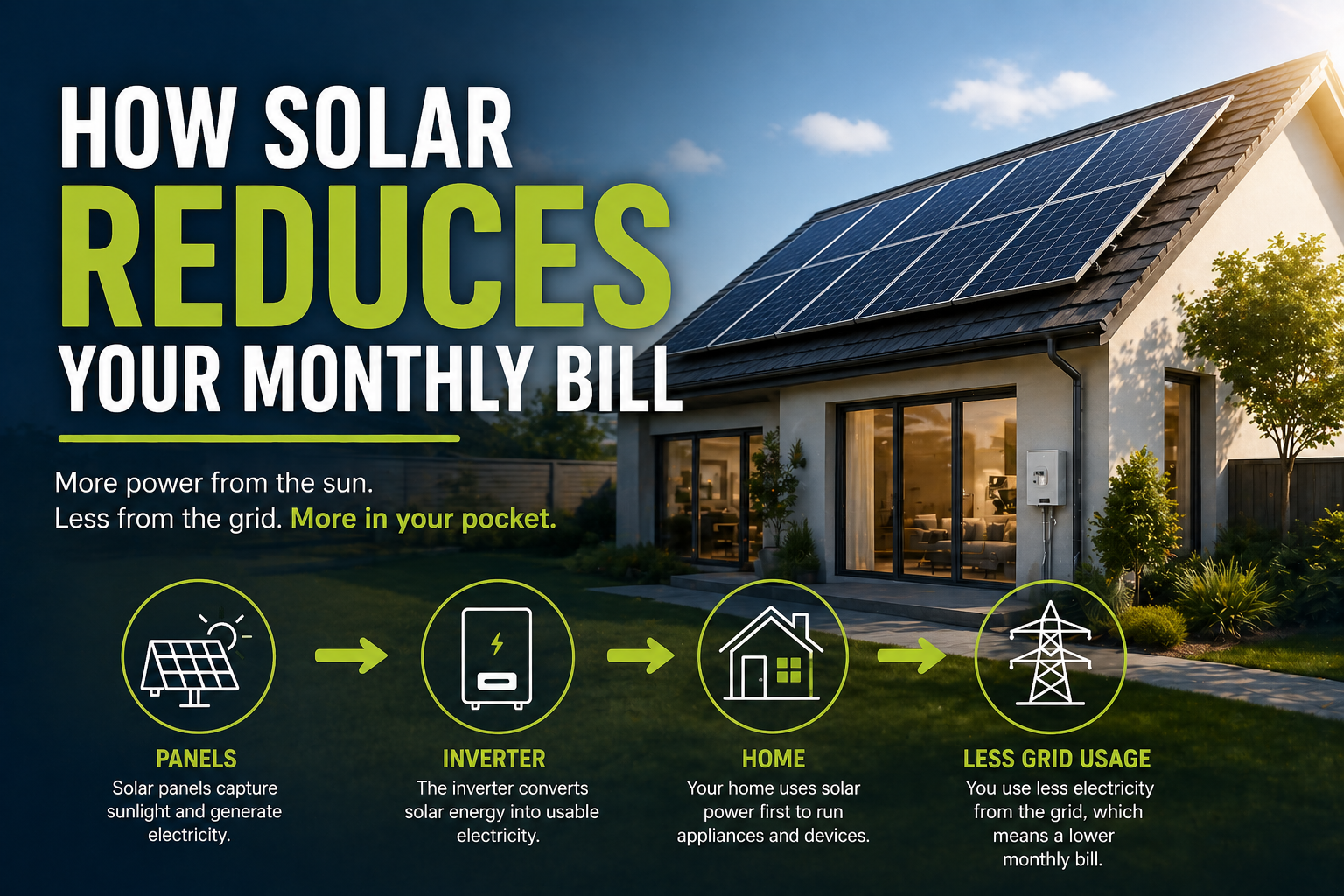
Solar does not just reduce how much electricity you use.
It changes how much you depend on the grid.
1. You Buy Less Electricity Overall
- Lower kWh consumption from the grid
- Direct reduction in usage-based costs
2. You Avoid Peak Pricing
- Solar produces power during the day
- This offsets some of the most expensive electricity periods
3. You Reduce Exposure to Increases
- Less reliance on the grid means less exposure to tariff hikes
- Your cost structure becomes more stable over time
4. You Gain Predictability
One of the biggest advantages is not just savings.
It is control.
- More predictable monthly costs
- Less volatility
- Better long-term planning
Important Clarification
Solar does not eliminate all costs.
- Fixed charges may still apply
- Grid connection fees may remain
However:
It reduces your dependence on the most volatile and expensive parts of your bill.
A Practical Way to Think About It
Without solar:
- You are fully exposed to the pricing system
With solar:
- You partially step outside of it
What You Can Do Next
Take your latest electricity bill and review:
- How much is actual usage
- How much is fixed or structural
- Whether you are being affected by time-of-use pricing
This gives you a clearer understanding of where your costs are coming from.

Resources to Verify and Learn More (South Africa)
Regulatory
- NERSA (National Energy Regulator of South Africa)
https://www.nersa.org.za
Tariffs and Pricing
- Eskom Tariffs and Charges
https://www.eskom.co.za - City of Cape Town Electricity Tariffs
https://www.capetown.gov.za - City of Johannesburg Tariffs
https://www.joburg.org.za - eThekwini Municipality
https://www.durban.gov.za
Industry and Market Insights
- SAPVIA (South African Photovoltaic Industry Association)
https://www.sapvia.co.za - GreenCape Energy Reports
https://www.greencape.co.za
Final Perspective
Most people try to fix their electricity bill by changing behaviour.
But the larger issue is structural.
Once you understand the system, the question changes from:
“How do I use less electricity?”
to:
“How do I reduce my exposure to this pricing structure?”
Leave a Reply